Microduck
pollen-robotics/microduckTiny open-source biped robot
PersonalAutomationLibrary / SDKPermissiveAt a glance
- stars on GitHub
- 14k
- contributors
- 27+
- last commit
- latest release, yesterday
- daemon-v0.23.1
- license
- Apache-2.0
About
The onboard software of Microduck, a 25 cm, 800 g walking robot from Pollen Robotics and Hugging Face that walks, sits, kicks a ball, gets back up after a fall and roller-skates using reinforcement-learning policies. It is a set of Rust daemons for the robot's Rockchip board: a 50 Hz control loop for fifteen servos, gamepad and Bluetooth control, a camera stream over WebRTC and safe updates with rollback.
From the repository: “A Tiny biped duck robot 🦆”
What is Microduck?
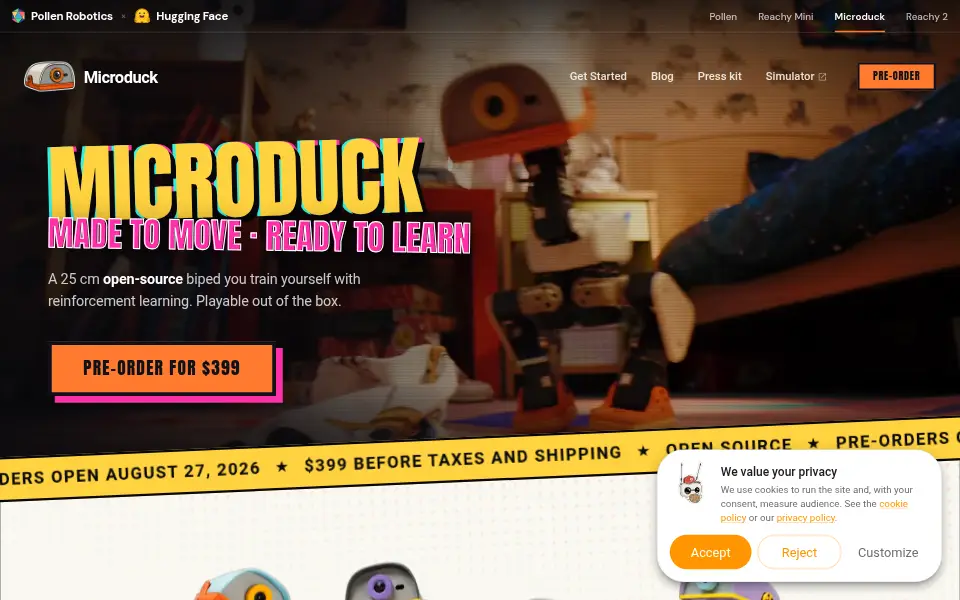
Microduck is a small two-legged robot shaped like a duck, made by Pollen Robotics, which is part of Hugging Face. It is about 25 cm tall, weighs about 800 g and has fifteen motors, a camera, a depth sensor and two motion sensors. It walks, sits and stands, kicks a ball, picks things up with its beak, rolls on skates and stands up again after a fall. Every move is a neural-network policy trained in simulation. This repository is the robot's software; the training code lives in the separate microduck_rl repository.
How much does Microduck cost?
In November 2026 the Pollen Robotics website lists Microduck for pre-order at $399 before taxes and shipping, called an introductory price. Pre-orders opened on 27 August 2026. The box contains the robot, a battery, a USB-C cable and a game controller. Optional packs cost extra: a charger pack ($39), a dev pack with spare motors, cables, batteries and tools ($119), and an accessory pack with rollers, a ball and NFC tags ($39). The robot comes in four colours. Check the website for current prices and shipping dates.
Can I use Microduck without the robot?
Yes, for software work. The scripts/duck-sim command runs the real robot daemons against a simulated duck in MuJoCo, so you can work on the control loop, policies and the robotctl tool on a laptop. It cannot test hardware drivers such as the servo bus, Bluetooth, camera or NPU. To train new moves you use the microduck_rl repository, which needs a CUDA GPU and the uv tool; its README says a usable walking gait takes about one to two hours with 4,096 simulated robots. Without a GPU you can run training on Hugging Face Jobs.
What are the alternatives to Microduck?
No other project in our catalog is a small legged robot yet. The closest open project is Open Duck Mini (apirrone/Open_Duck_Mini): a community-built miniature of Disney's BDX droid, about 42 cm tall, with a target parts cost under $400. You build it yourself, and its README calls the repository a working hub with many undocumented scripts. Microduck is smaller, comes as a finished robot and has a full software stack with signed updates. Open Duck Mini is not in our catalog yet.
What are the limits of Microduck?
It is a new product: the repository was created in July 2026 and the robot ships on pre-order. The board is a Radxa Zero 3, and the project's FAQ says its NPU can run a small detector and little more, so larger AI models must run elsewhere, for example in a Hugging Face Space that receives the camera stream over WebRTC. Remote video that passes through a relay counts against a monthly bandwidth limit on the owner's Hugging Face account (10 GB on the free tier), and a 720p stream uses about 1 GB per hour.
Is Microduck open source?
The software is. This repository and the microduck_rl training code are under the Apache 2.0 license, so you can read, change and reuse them, including commercially. The website describes the SDK, the simulation and the full training stack as open source, and the trained policies for every shipped move are published so you can retrain them. This repository holds the software only; check the Pollen Robotics website if you need hardware design files. The robot itself is a commercial product you buy from Pollen Robotics.
Why it's in the catalog
For makers, students and robotics fans who want a small legged robot whose moves they can retrain, not just a toy with fixed tricks. You need the robot from Pollen Robotics or the MuJoCo simulator, and a CUDA GPU or Hugging Face Jobs to train new behaviours. If you would rather build a duck robot yourself from an open design, look at Open Duck Mini.
Get it
git clone https://github.com/pollen-robotics/microduck_rl
cd microduck_rl
uv run train Mjlab-Velocity-Flat-MicroDuck --env.scene.num-envs 4096
git clone https://github.com/pollen-robotics/microduck
cd microduck
scripts/duck-sim
Downloads
All releases on GitHub ↗Latest release: daemon 0.23.1, . Its files were downloaded 87 times.
All files (8)
Other files
- manifest.json491 B · 35 downloads
- 0.23.1.manifest.json335 B · 6 downloads
- daemon-0.23.1.tar.zst19 MB · 6 downloads
- updaterd-bootstrap-aarch6411 MB · 2 downloads
To check the files: 0.23.1.manifest.json.minisig, daemon-0.23.1.tar.zst.minisig, manifest.json.minisig, updaterd-bootstrap-aarch64.minisig
These files come from the project's GitHub release. DigGitHub does not check them.